

- One-time infusion of anzu-cel (anzutresgene autoleucel, IMA203) PRAME cell therapy in 16 patients with metastatic uveal melanoma in the ongoing Phase 1b trial continues to show strong clinical benefit with more mature data: cORR of 67%, mDOR of 11.0 months, mPFS of 8.5 months and mOS not reached at 14.3 months mFU
- Anzu-cel maintains a favorable tolerability profile in metastatic uveal melanoma
- Anti-tumor activity observed across metastases throughout the body, including liver lesions, and in patients who received prior treatment with TCR-based therapies
- Given the promising clinical activity of anzu-cel and high PRAME prevalence in uveal melanoma, a Phase 2 cohort has been initiated in patients with metastatic uveal melanoma
The uveal melanoma data from the ongoing Phase 1b trial will be presented today at the
“Patients with metastatic uveal melanoma face a poor prognosis and represent a population in need of better outcomes, given the limited options currently available,” said
“Our goal is to leverage every opportunity to bring innovative PRAME therapies to patients with limited treatment options,” said
Presidential Symposium III Presentation Summary – Anzu-cel Phase 1b Trial
Patient Population: Difficult-to-treat patient population with metastatic uveal melanoma
As of
Anti-tumor Activity and Durability: Continued strong anti-tumor activity and durability of anzu-cel PRAME cell therapy
Updated data of a one-time infusion of anzu-cel PRAME cell therapy demonstrated promising benefit in a difficult-to-treat population with limited effective treatment options:
- Confirmed objective response rate (cORR) of 67% (10/151)
- Disease control rate (DCR) of 88% (14/16)
- Median duration of response (mDOR) of 11 months (min 4.4, max 31.6 months)
- Median progression-free survival (mPFS) of 8.5 months (min 1.4, max 32.9) at a mFU of 10.4 months. The PFS rate was 69% at six months and 39% at 12 months
- Median overall survival (mOS) not reached (min 4.3+, max 34.2+ months) at a mFU of 14.3 months. The OS rate was 71% at 12 months
Anti-tumor activity was observed in liver and extrahepatic metastases, including lung, lymph node, abdomen/peritoneum and others. 14/16 patients had target lesions in the liver and treatment with anzu-cel led to a median shrinkage in liver target lesion size of 49.6%.
Notably, 11 out of the 16 patients received a TCR bispecific (ten gp-100-targeting, one PRAME-targeting) as prior systemic treatment line, and thereof, six achieved a confirmed partial response, one a partial response and three stable disease. These results demonstrate anti-tumor activity of anzu-cel in patients who received prior TCR-based therapies.
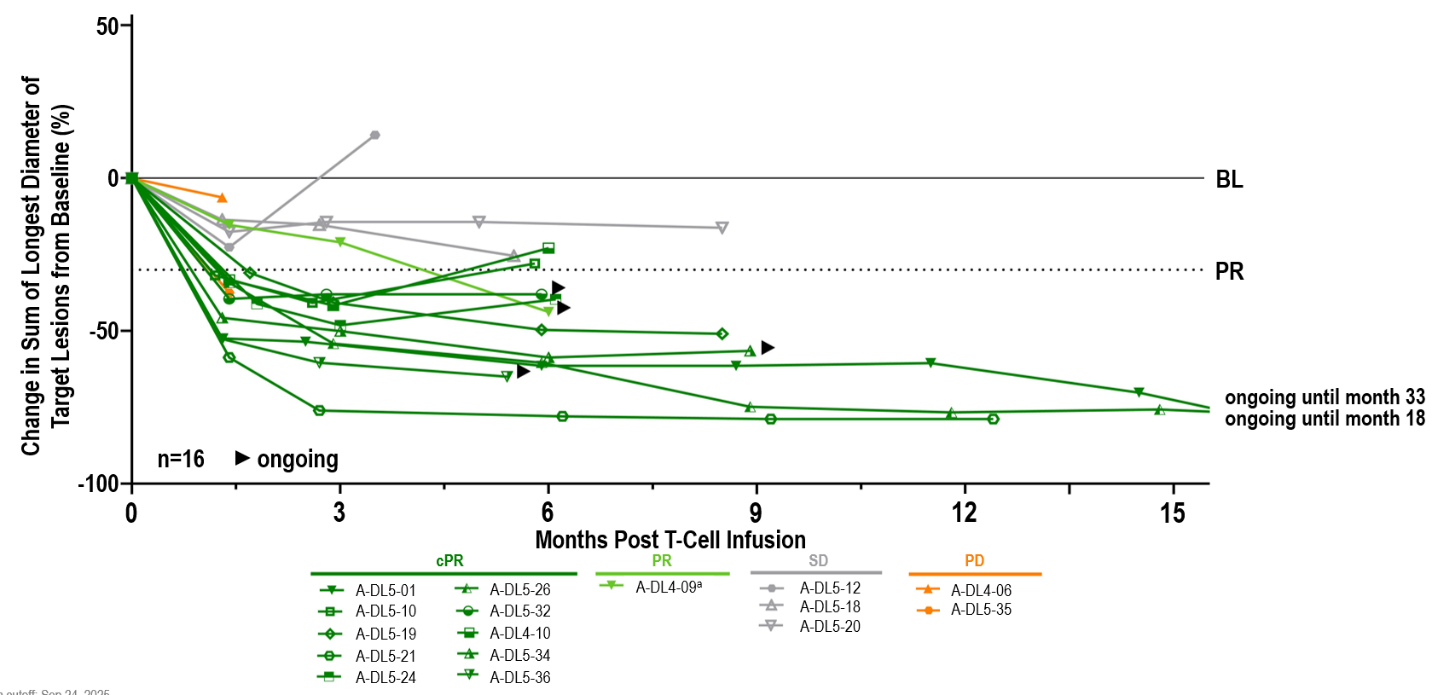
aPatient out of study at data cutoff (withdrew consent); BL, baseline; (c)PR, (confirmed) partial response; PD, progressive disease; SD, stable disease.
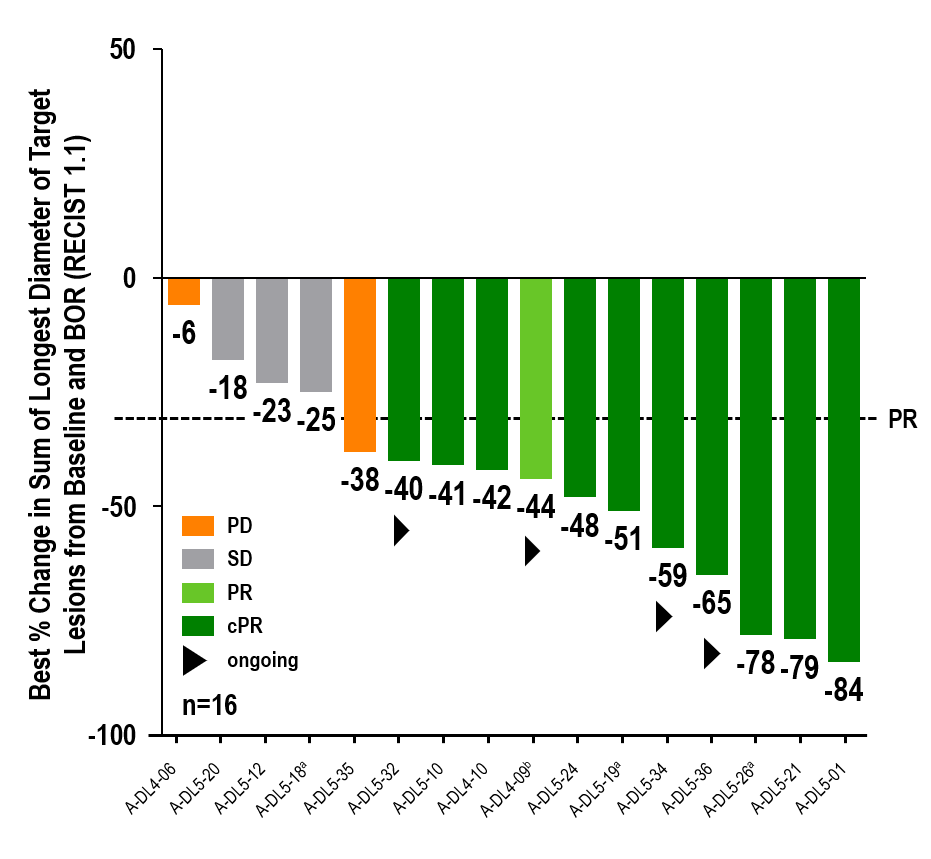
aMaximum change of target lesions and RECIST1.1 response at different timepoints. bPatient off study at data cutoff date (withdrew consent). 14/16 patients had liver target lesions with median best change of longest diameter of liver target lesions (range) of -49.6% (-100, 10). BOR, best overall response; cPR, (confirmed) partial response; RECIST, Response Evaluation Criteria in Solid Tumors; SD, stable disease; PD, progressive disease.
Safety: Favorable tolerability in uveal melanoma, generally consistent with full anzu-cel tolerability profile
The most frequent treatment-emergent adverse events (TEAs) were anticipated cytopenias associated with lymphodepletion. Expected and manageable cytokine release syndrome (CRS) was mostly Grade 1 or 2, which is consistent with the mechanism of action (Grade 1: 37.5%, Grade 2: 43.8%, Grade 3: 18.8%, Grade 4: 0%). No patients experienced long-term CRS, and most CRS was resolved by day 14. No anzu-cel-related Grade 5 events were observed.
Tolerability in the uveal melanoma subset was generally consistent with the full anzu-cel tolerability profile in the Phase 1b.
Development Path for Anzu-cel in Metastatic Uveal Melanoma
Based on the promising clinical data in patients with metastatic uveal melanoma,
The consistent tolerability, anti-tumor activity and pharmacokinetic profile of anzu-cel across both uveal and cutaneous melanoma provide a strong rationale for pursuing a parallel late-stage development strategy to serve both patient populations.
About PRAME
PRAME is a target expressed in more than 50 cancers.
About Anzu-cel (IMA203) PRAME Cell Therapy
Anzu-cel (anzutresgene autoleucel; IMA203) is a PRAME-directed TCR T-cell therapy engineered to recognize an intracellular PRAME-derived peptide presented by HLA-A*02:01 on the cell surface and initiate a potent and specific anti-tumor response. Anzu-cel PRAME cell therapy is currently being evaluated in a registration-enabling randomized controlled Phase 3 trial, “SUPRAME,” in patients with unresectable or metastatic cutaneous melanoma who have disease progression on or after treatment with at least one checkpoint inhibitor. In parallel, the Phase 1b clinical trial in patients with PRAME cancers is ongoing with a focus on uveal melanoma.
About
Forward-Looking Statements
Certain statements in this press release may be considered forward-looking statements. Forward-looking statements generally relate to future events or the Company’s future financial or operating performance. For example, statements concerning timing of data read-outs for product candidates, the timing, outcome and design of clinical trials, the nature of clinical trials (including whether such clinical trials will be registration-enabling), the timing of IND, CTA or BLA filings, estimated market opportunities of product candidates, the Company’s focus on partnerships to advance its strategy, and other metrics are forward-looking statements. In some cases, you can identify forward-looking statements by terminology such as “may”, “should”, “expect”, “plan”, “target”, “intend”, “will”, “estimate”, “anticipate”, “believe”, “predict”, “potential” or “continue”, or the negatives of these terms or variations of them or similar terminology. Such forward-looking statements are subject to risks, uncertainties, and other factors which could cause actual results to differ materially from those expressed or implied by such forward-looking statements. These forward-looking statements are based upon estimates and assumptions that, while considered reasonable by
For more information, please contact:
Media
Phone: +49 151 74416179
immatics@trophic.eu
Head of Strategy
Phone: +1 346 319-3325
InvestorRelations@immatics.com
- END -
1Excluding one patient who withdrew consent with ongoing unconfirmed response.
Attachment